America Needs Election Rules That Voters Can Trust
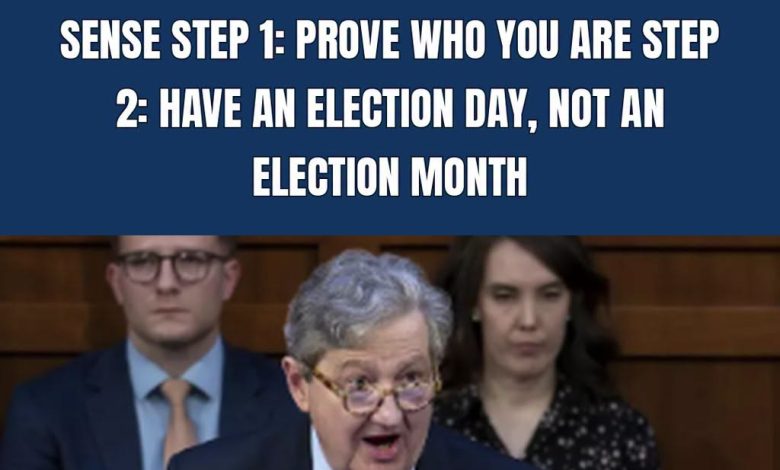
Election integrity should not be treated as a partisan issue. Every eligible American citizen deserves the right to vote, and every voter deserves confidence that the rules are clear, consistent, and secure.
Senator John Kennedy has promoted a straightforward approach centered on two priorities: requiring reliable voter identification and returning greater emphasis to a clearly defined Election Day.
Supporters of voter identification argue that confirming a person’s identity is a reasonable safeguard, not an attempt to suppress participation. Americans routinely provide identification when boarding airplanes, opening financial accounts, applying for employment, or completing other important transactions. From that perspective, asking voters to verify their identity helps ensure that each lawful ballot is connected to an eligible voter.
However, a workable policy must also recognize that some eligible citizens may have difficulty obtaining acceptable identification. Any serious voter-ID proposal should therefore include free identification, accessible registration assistance, and reasonable procedures for elderly, disabled, rural, and low-income voters. Security and accessibility do not have to be competing goals.
Kennedy’s second proposal focuses on reducing lengthy voting periods and restoring Election Day as the central moment of the democratic process. Advocates believe that extended mail-voting windows can create administrative complications involving ballot handling, signature verification, collection practices, and chain-of-custody procedures.
A more concentrated voting period, they argue, could make election administration easier to observe and understand. Clear deadlines, transparent ballot tracking, bipartisan oversight, and prompt reporting standards could strengthen public confidence.
Still, eliminating early or absentee voting entirely would create serious obstacles for military personnel, Americans living overseas, people with disabilities, hospital patients, caregivers, and workers unable to leave their jobs on Election Day. A responsible reform plan should preserve legitimate absentee options while strengthening verification and ballot-security procedures.
The strongest case for election reform is not that every disputed election involved widespread fraud. Such claims require credible evidence. The stronger argument is that election systems should be designed to minimize vulnerabilities, reduce public confusion, and produce results that citizens across the political spectrum can accept.
Americans should not have to choose between ballot access and election security. The country can protect both by adopting practical safeguards:
Proof of identity for voting, free and accessible identification, accurate voter rolls, secure absentee-ballot procedures, transparent counting, bipartisan observers, and consistent enforcement of election laws.
Trust cannot be restored through slogans or accusations alone. It must be earned through rules that are understandable, auditable, and applied equally.
Only eligible citizens should vote. Every eligible citizen should have a fair opportunity to vote. And every lawful vote should be counted exactly once.
That is not an extreme position. It is the foundation of a credible democratic system.