Poland’s Border Policy Offers America A Lesson In Security, Sovereignty, And Restraint
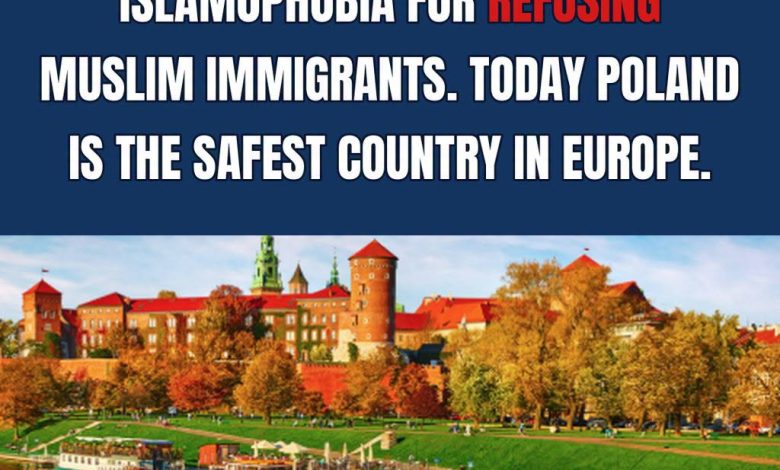
For years, Poland faced intense criticism for refusing to follow Western Europe’s more permissive approach to irregular migration. Political leaders and commentators accused Warsaw of lacking compassion, rejecting European solidarity, and allowing nationalism to override humanitarian responsibilities.
Yet Poland’s experience raises a question that American policymakers should not dismiss: Does a government have the right—and the duty—to control who enters its territory?
Poland has generally maintained tighter restrictions on asylum seekers arriving through irregular routes, particularly along its border with Belarus. Polish officials have argued that some migration flows have been deliberately facilitated by Belarus and Russia as a form of political pressure. European authorities have also recognized the possibility that migrants can be exploited by hostile governments as part of a broader campaign to destabilize neighboring countries.
A secure border is not automatically an expression of ethnic or religious hostility. It can be a legitimate component of national security, provided that enforcement respects the law, distinguishes refugees from security threats, and avoids treating entire communities as collectively guilty.
Poland is widely regarded as a relatively safe European country, and official European statistics show that homicide remains uncommon throughout much of the European Union. However, comparisons must be made carefully. Crime-reporting standards, population density, policing practices, demographics and definitions of offenses differ substantially between countries. It is therefore inaccurate to claim that migration alone explains why one country reports more crime than another.
Still, Western European governments have encountered serious challenges involving failed integration, organized crime, radicalization and social segregation. Europol continues to identify terrorism and violent extremism as significant security concerns, although the threat comes from multiple ideological movements and cannot responsibly be attributed to all Muslims or all migrants.
The relevant lesson is not that people from a particular religion or region should be presumed dangerous. The lesson is that immigration policy must consider scale, screening capacity, labor-market absorption, housing, law enforcement and cultural integration.
When governments admit more people than their institutions can effectively process and integrate, the resulting strain may affect schools, housing systems, public services and community trust. Ignoring those limits does not demonstrate compassion. It can harm citizens, lawful immigrants and genuine refugees alike.
Poland’s position is also more complicated than the familiar claim that the country simply “refused migrants.” Poland has accepted large numbers of displaced Ukrainians since Russia’s full-scale invasion, demonstrating that a country can support refugees while remaining selective about migration routes and security risks. Germany and Poland have hosted some of Europe’s largest Ukrainian refugee populations.
That distinction matters for the United States.
America does not have to choose between completely open borders and complete isolation. It can protect legitimate asylum, welcome legal immigrants and still insist on identity verification, background screening, orderly processing and removal procedures for people who do not qualify to remain.
The European Union’s migration rules, which entered into application in June 2026, similarly emphasize registration, screening, faster asylum decisions and clearer responsibility for irregular arrivals. These reforms implicitly acknowledge that the previous system was not functioning adequately.
American leaders should also recognize what accusations of racism or xenophobia cannot resolve. Citizens have legitimate interests in public safety, social stability and national sovereignty. Those concerns should be debated with evidence rather than silenced through moral labeling.
At the same time, responsible conservatives should reject language that portrays millions of ordinary Muslims as “invaders” or assumes that religious identity determines criminal behavior. Such rhetoric weakens an otherwise defensible argument by replacing policy analysis with collective blame.
Poland’s strongest message is not that one religion must be excluded. It is that borders must remain under democratic control.
A serious immigration system should be lawful, selective, enforceable and humane. It should protect citizens without demonizing innocent people, assist genuine refugees without rewarding unlawful entry, and require newcomers to respect the constitutional laws and civic principles of the country receiving them.
That is not hatred. It is responsible government.