If you know, you know.
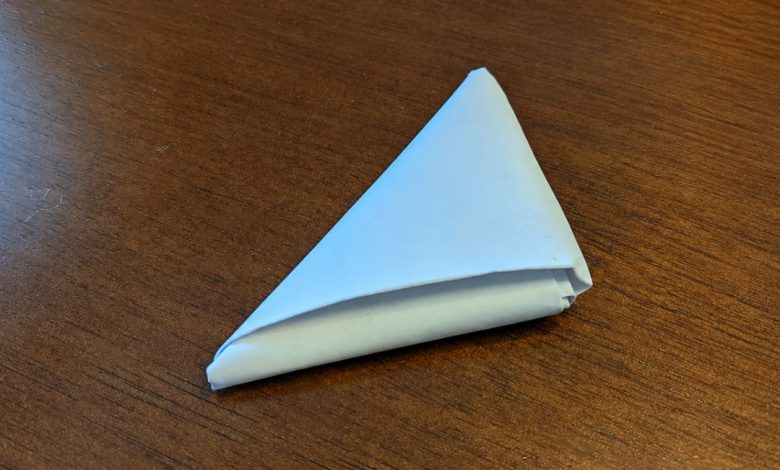
The object in the photo is called a paper football. It is a small triangle-shaped “ball” folded from paper, usually made from notebook paper, printer paper, or scrap paper. In the United States, it is also sometimes called flick football, tabletop football, or finger football because players move it by flicking it with their fingers.
Paper football does not have one clearly proven inventor. Its exact origin is disputed, but it became especially familiar in American school culture by the late 1960s and early 1970s. One commonly mentioned early history says it was being widely played in youth groups and churches in Madison, Wisconsin, in the early 1970s.
The game was popular because it needed almost nothing: one piece of paper, a flat table, and two players. Students often played it during lunch, study hall, or free time. The folded triangle acted as the football, and the tabletop became the field.
The basic goal was simple. A player would flick or slide the paper football across the table and try to make it stop with part of the triangle hanging over the opponent’s edge. That was usually counted as a touchdown. After that, the scoring player could try a field goal by flicking the paper football through goalposts made with the other player’s fingers.
Its main purpose was entertainment. Paper football was a cheap, quick, and creative classroom or cafeteria game. It turned an ordinary sheet of paper into a miniature sports game, which is why so many Americans who grew up before smartphones remember it with nostalgia.
Important note: paper football is not an official sport and its rules were never completely universal. Different schools, families, and friend groups often had their own versions. That loose, homemade quality is exactly what made it memorable.